
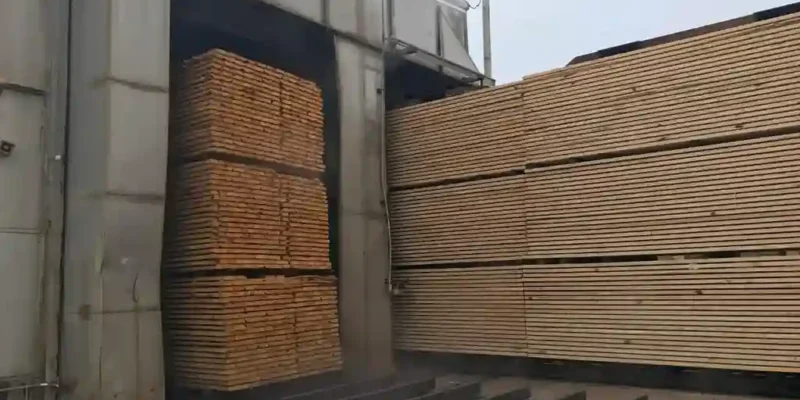
The wood industry has evolved significantly in recent years thanks to technologies that improve durability and performance. Among the most important processes are industrial kiln drying and autoclave treatment.
These technologies transform wood into a highly resistant material, ideal for demanding outdoor and high-humidity environments.
What Is Industrial Wood Drying?
Industrial drying is carried out in kilns that control temperature, humidity, and airflow to reduce moisture content in a controlled and uniform way.
This process allows:
- prevention of warping
- improved dimensional stability
- reduction of fungi and insect risks
- preparation for further treatment processes
The U.S. Forest Service highlights that controlling moisture content is essential for wood’s structural performance.
What Is Autoclave Wood Treatment?
Autoclave treatment is an industrial process in which wood is placed in a pressure chamber to allow deep penetration of protective preservatives.
During the process:
- air is removed from the wood cells
- preservatives are introduced
- pressure is applied to ensure deep and uniform absorption
This results in wood that is highly resistant to:
- extreme moisture
- insects
- fungi
- harsh environmental conditions
Advantages of Autoclave Treatment
Increased durability
Treated wood can last significantly longer in outdoor environments.
Resistance to extreme conditions
Ideal for tropical, humid, or coastal areas.
Reduced maintenance
Minimizes the need for frequent repairs.
Long-term investment protection
Prevents premature replacement of materials.
Applications of Treated Wood
Thanks to these technologies, treated wood can be used in demanding projects such as:
- decks
- palapas
- docks and piers
- tourism infrastructure
- exterior architectural elements
This is especially important in destinations like the Mexican Caribbean, where environmental conditions are more aggressive.
Innovation in the Wood Industry
The use of technologies such as industrial drying and autoclave treatment has raised the quality standards of wood products, making them more competitive with other construction materials.
These processes also contribute to more efficient resource use by extending the lifespan of wood.
Conclusion
Autoclave treatment and industrial drying are two of the most important technologies in the modern wood industry. These processes allow wood to achieve high levels of durability, stability, and resistance, even in challenging environments.
Investing in properly treated wood ensures safer, longer-lasting, and higher-quality construction projects.
